


The Rhythms of Life
This week, explore your relationship to the rhythms of nature.
By this I mean, there are the rhythms of nature,
And there is your personal relationship with those rhythms. This relationship is a mystery to be explored.
Rhythms are everywhere, from the subatomic, to the vibration of molecules, to cells, organs, organisms, climates, the orbits of planets, and the orbits of solar systems around galactic cores.
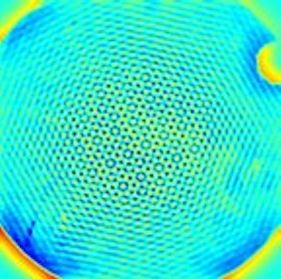
Magnetic rhythms

Rhythms in a lake

The rhythm of a dancer

Rhythm of many dancers

Mondrian - Rhythm of Black Lines


Rhythms in the brain's electricity

The rhythm of a pitch

Photographs of violin sounds vibrating matter
see more rhythms here.
Rhythm Explorations
Pause in various moments of sensory experience –
-- when smelling something delightful, when gazing out over a beautiful morning, when seeing a baby or dog or child or friendly face.
Pause and appreciate the rhythm of the experience.
Even if you are standing still, gazing at a painting, there is a rhythm to the way your eyes coast over the colors.
If you are listening to music, there is a rhythm evoked in your body, that is your response to the music.
Really listening means listening to yourself as well as the music, for you are in that moment an instrument that is being played by life.
The rhythm of a breath
Your breathing is an aspect of nature, as natural as a whale breathing as it swims by,
As natural as the breath of an angel on the ceiling.
Some time – any time – pause in the midst of your day.
Pause for a minute at the beginning of the day or the end.
Notice the rhythm of your breathing, and sense what you like about it.
Play with tiny changes – do you like to extend the rhythm here or there,
shorten the inbreath, or make the turn from in to out, or out to in.
Then go back to letting the breath have its own rhythm and simply appreciate it.
After a minute of noticing and enjoying the breath, think the thought, "This is the rhythm of my being."
The rhythm of walking
When walking, notice the rhythm of your pace. Appreciate the speed you seem to enjoy the most.
You have a rhythm and pace of walking that you favor.
The rhythm of a prayer
Memorize a poem or a prayer, or select one you already know.
There is something magical to knowing a prayer by heart.
"I know it by heart."
When we know something by heart, then we can say it in our own rhythm.
We can pause where we like. Linger in a beat. Then let the next word carry us.
Select something you love:
Adonai elohim.
Srutam deva maya sarvam
Our Father, Thou Art in Heaven, Hallowed by Thy Name.
At the still point of the turning world.
A sentence, a few words,
I am the Soul. The Soul am I.
Take a poem, prayer, or focusing thought. The Lord's prayer. The lyrics to a song.
A poem you love. A sutra.
Two words, three words, a sentence.
Devote 20 minutes or so to falling into rhythm with the prayer or poem.
Maybe, if that seems too long, give it 5 minutes.
Follow your rhythm with the prayer.
Notice where you like to pause, and delight in the silence before going to the next word.
You'll find sweet spots – a way of whispering this word, then lingering in the reverberations after that word.
Certain phrases make the silence feel rich.
- Lorin
Ray's word of the day, " ineluctable"
usage:
. . .ineluctable as gravity.
the innate restlessness of its inhabitants and the ineluctable attraction of an open road.
it captured some ineluctable truth about nature
The American Heritage Dictionary online-
http://www.bartleby.com/61/2/I0120200.html
ineluctable
SYLLABICATION: in·e·luc·ta·ble
PRONUNCIATION: n-lkt-bl
ADJECTIVE: Not to be avoided or escaped; inevitable: “Those war plans rested on a belief in the ineluctable superiority of the offense over the defense” (Jack Beatty).
ETYMOLOGY: Latin inluctbilis : in-, not; see in–1 + luctbilis, penetrable (from luctr, to struggle out of ( ex-, ex- + luctr, to struggle).
http://www.bartleby.com/61/78/R0227800.html
rhythm
PRONUNCIATION: rthm
NOUN: 1. Movement or variation characterized by the regular recurrence or alternation of different quantities or conditions: the rhythm of the tides. 2. The patterned, recurring alternations of contrasting elements of sound or speech. 3. Music a. The pattern of musical movement through time. b. A specific kind of such a pattern, formed by a series of notes differing in duration and stress: a waltz rhythm. c. A group of instruments supplying the rhythm in a band. 4a. The pattern or flow of sound created by the arrangement of stressed and unstressed syllables in accentual verse or of long and short syllables in quantitative verse. b. The similar but less formal sequence of sounds in prose. c. A specific kind of metrical pattern or flow: iambic rhythm. 5a. The sense of temporal development created in a work of literature or a film by the arrangement of formal elements such as the length of scenes, the nature and amount of dialogue, or the repetition of motifs. b. A regular or harmonious pattern created by lines, forms, and colors in painting, sculpture, and other visual arts. 6. The pattern of development produced in a literary or dramatic work by repetition of elements such as words, phrases, incidents, themes, images, and symbols. 7. Procedure or routine characterized by regularly recurring elements, activities, or factors: the rhythm of civilization; the rhythm of the lengthy negotiations.
ETYMOLOGY: Latin rhythmus, from Greek rhuthmos. See sreu- in Appendix I.
Etymology of rhythm:
Indo-European Roots
ENTRY: sreu-
DEFINITION: To flow.
Suffixed o-grade form *srou-mo-. a. stream, from Old English stram, stream;
b. maelstrom, from Middle Dutch stroom, stream. Both a and b from Germanic *straumaz, stream.
2. Basic form *sreu-. a. rheo-, –rrhea; catarrh, diarrhea, hemorrhoid, rhyolite, from Greek rhein, to flow, with o-grade rhoos, flowing, a flowing;
b. suffixed form *sreu-m. rheum, from Greek rheuma, stream, humor of the body.
3. Suffixed zero-grade form *sru-dhmo-. rhythm, from Greek rhuthmos, measure, recurring motion, rhythm.
4. Suffixed zero-grade form *sru-to-. rhyton, from Greek rhutos, fluid, liquid. 5. Perhaps zero-grade extended form *srug-. sastruga, from Russian struga, deep place. (Pokorny sreu- 1003.)
From the Math department at the University of Glasgow:
http://www.maths.gla.ac.uk/~fhg/waves/waves1.html
What is a wave?
A wave is a pulse of energy. Waves carry energy away from a central transmitter. Mechanical waves, such as sound waves, need some medium of transmission. Electromagnetic waves, for example radio waves, can carry energy through a vacuum. If a wave is travelling through a medium, the particles of the medium do not move along with it. They vibrate about their equilibrium position, and the energy is transmitted through the interaction of neighbouring particles.
- Let me know if you ever want to unsubscribe from the meditation email list!