


Come to Your Senses
Aristotle did some harm to the world of philosophy by proposing only five senses: vision, hearing, touch, taste, smell. How could he leave out balance?
Consider that it is still sort of daring to propose a sixth sense. Wu-hu, a sixth sense! Wake up, sleepwalkers, and check out twenty senses, more or less.
As with so many things, it's astounding to realize that in thousands of years, so little actual empirical research has been done that finds its way into the common language. How about balance? Balance is a wonderful sense, ecstatic in its own way, with its own elaborate sensory structures in the inner ear, and its own pathways in the brain. Tilt your head to one side, and move it very slowly in some direction, and savor that sensation. Balance lets you walk with ease, and adds richness to every movement.
There is also a joint position sense. We know, without looking, the angle of our joints. In class, i sometimes turn out the lights and ask people to move around slowly with their eyes closed. Then after a minute, I'll say, "Notice the position of your skeleton in space." Most people click into an inner knowing, an almost but not quite visual sense of how the limbs and joints are arrayed.
And further, there is "muscle stretch" sense. We can feel the deep tissue in the body, the muscles. Of course.
So if you close your eyes and tilt your head, three senses at least jump up: balance, joint position, and muscle stretch. These tell you the angle of your head and its position in space.
There is even a fourth sense at play, which is the skin - when I tilt my head over, I can feel the skin stretching slightly, in addition to the other senses. Which brings us to the skin, a wonderful organ of life and a great invention.
We could consider "skin senses" to be one sense – it's your call. But notice that light touch, which tickles the hairs, is a sense of its own. That is what you feel when a breeze blows over your arms or legs. Firm touch, which actually moves the skin, is what you feel when someone grabs you or massages you.
Now breathe out and don't breathe in again until you are really hungry for air. Come on - check it out. So duh, we have an oxygen sense. Of course we have an oxygen sense. Do you think Life would wander around this planet for a billion years and NOT develop senses that inform you, instant-by-instant, of the level of oxygen and carbon dioxide in your blood?
Each of these senses is delightful and a world to explore. So break out of this trap of "five-ness" and start adding senses, become intimate with more and more variety and range. The senses are a bit like dogs, they are so grateful if you will just take them for a walk every day.
In Meditation Made Easy somewhere, there is an exercise of scanning the senses, honoring the senses.
What you can do as a daily practice is select a sense or a sensory submodality, and indulge it for a few minutes each day. Take it for a walk!
For example, take a walk and consciously attend to your peripheral vision for a bit. It's a whole different way of seeing.
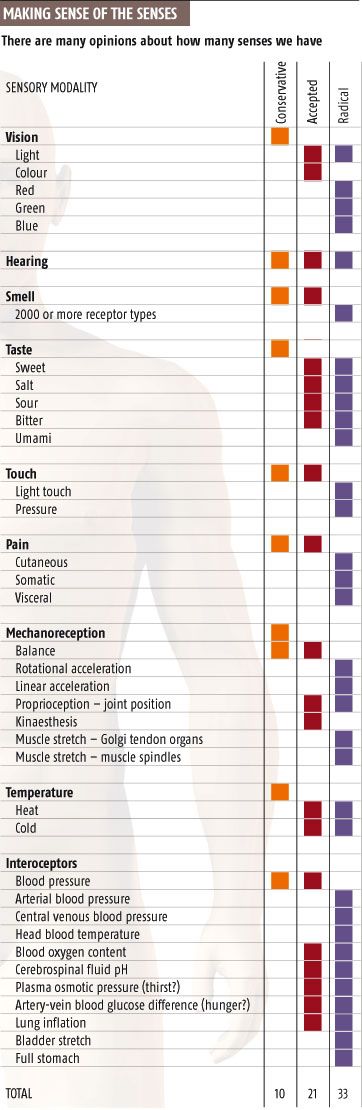
Now check out submodalities of the senses. It gets even more fun! continue . . .
Recommended reading:
Meditation Made Easy, Lorin Roche
A Natural History of the Senses, Diane Ackerman