
Pranayama and the Chakras
As living beings, we are part of the life of the planet and actually the whole solar system. Earth gets its light and warmth from the Sun. We exchange energy most intimately with the earth and the ocean of air surrounding our planet. Every minute, day and night, conscious or unconscious, we fill our lungs with air, absorb the oxygen, then we breathe out the excess carbon dioxide. We breathe in and out 12 to 18 times a minute. This is an exchange of substance and energy on a physical level.
On the level of subtle magnetism – not the electromagnetism we use and pay for with our electric bill – but life magnetism, bioenergetics, we also exchange energies with the earth and the Sun.
Life is always pulsating in our bodies. When we allow this pulsation to enchant us and call us inward, this is meditation. When we ride those currents outward, we are led into passionate creative expression. Thus peace and passion are intimately interwoven.
Nature tends to organize herself through vortexes, spiraling flows. So as the energy flows into the body, through the body, and outward from the body, there are vortexes. In Sanskrit these are called chakras.
We can define meditation as “paying attention to the flow of life through the body.” Any interface, any area in which our energies have contact with each other or with the larger universe can be a point of focus. We can meditate (or practice pranayama or dharana) on the relationship of the pelvic vortex and the heart vortex, or the relationship of the heart vortex and the environment, for example.
For thousands of years, the various yoga traditions, meditation traditions, and martial arts schools across Asia have held that the human body has a series of energy vortices in and around it. Usually the maps and charts from these traditions are overly simplistic, and haven’t been updated for hundreds or thousands of years. They are passed on by tradition, without having anyone clairvoyant check their accuracy. This is partly because traditions are traditional, not empirical. They are not interested in doing research, but rather in memorizing and transmitting the research that someone somewhere did thousands of years ago. Each tradition tends to have a different schema and varying number of chakras.
Many systems map out 7 major chakras, up to 21 relatively minor chakras, and hundreds of mini-chakras. In yoga, there are also considered to be 72,000 nadis, or channels through which the prana flows. In acupuncture, there are meridians through which the chi flows.
Here are some interesting images of the chakras from various sites:


courtesy of Bruce Berger at http://weare1.us/, Polarity Energy Balancing

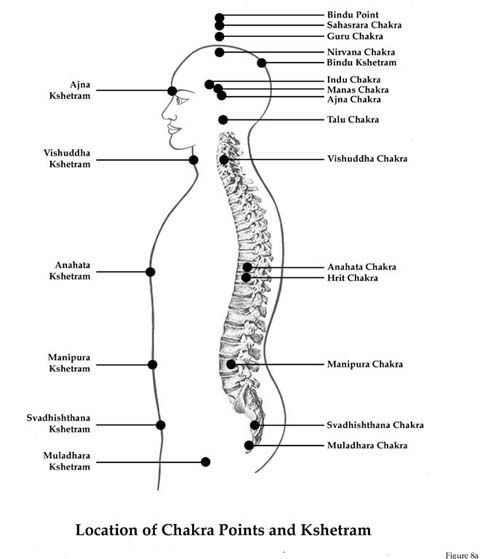
Found here.

Found at KJmaclean.com

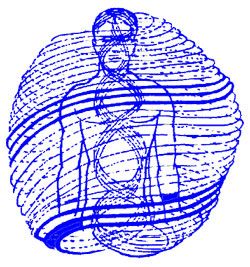
Found at Golden Ratio

courtesy of Bruce Berger at http://weare1.us/, Polarity Energy Balancing

Acupuncture chart from Hua Shou (fl. 1340s, Ming dynasty, China)

Link to a short movie visualizing the chakras, by Anodea Judith, Alex Wayne, and Robin Silver.
Vortexes in Nature
The energy vortexes - or chakras, as they are called in Sanskrit, have similarities to vortexes in water and air.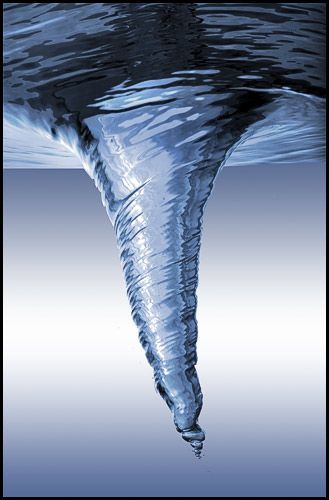
A vortex in water. Photo by Paul Groom.

Vortex in the air behind an airplane
What is a vortex? (From answers.com)
- A spiral motion of fluid within a limited area, especially a whirling mass of water or air that sucks everything near it toward its center.
- A place or situation regarded as drawing into its center all that surrounds it: “As happened with so many theater actors, he was swept up in the vortex of Hollywood” (New York Times).
- [Latin vortex, vortic-, variant of vertex, from vertere, to turn.]
The Earth, or rather the weather, often manifests vortexes. You could say, nature organizes her energy flows through vortexes.

Hurricane Katrina (NASA)
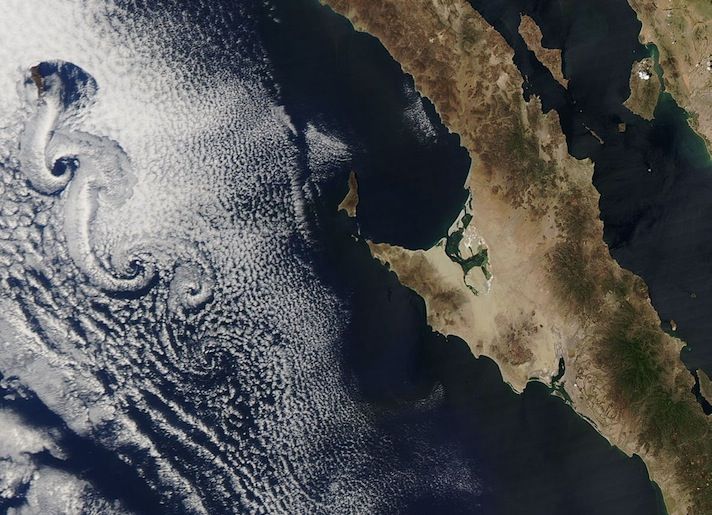
Vortexes in the clouds over the ocean
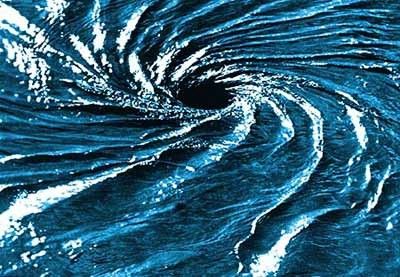
vortex in water

Vortex on Jupiter
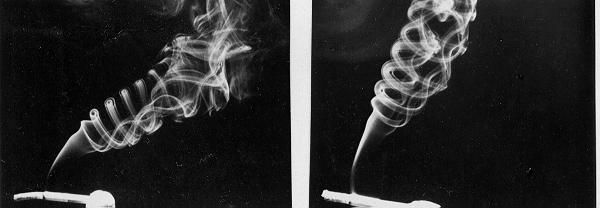
Vortex in cigarette smoke
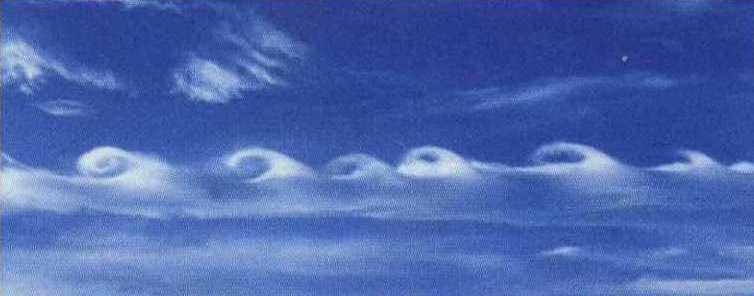
Vortex in clouds
The Vortex Explained
Peter Proctor -- Grasp the Nettle
Have you ever noticed that water from a hose pipe running down a paved path does not go in a straight line? It starts to move of itself -- it meanders and spirals, and if you observe closely, you will see a pulsing movement. This pulsing is the beginning of the vortex.
The form of the vortex is manifested in many different ways in nature. Galaxies, for instance, move around in great spirals, and spiral movements are the basis of cyclones and anticyclones in weather systems. Observation of the connection of the vortex with life may help the understanding of biodynamic practices, such as the stirring of the preparations.
What happens in a vortex?
There is a continuous, two-way rhythmical movement of water (or air), expanding and contracting. The water is moving at different speeds - slower at the edge and faster as it moves inwards and downwards and then up and out again. It is amazing that no particle of water is moving at the same speed as any other.
In a large enough body of water the particles furthest from the vortex do not move at all and become still. In a running stream you can see all kinds of intricate swirling and vortices as the water moves in many different ways at once.
Vortexes in the Creation of Suns and Planets
April 2008: Powerful Black Hole Jet Explained
“A recent article on Space.com which references a video of what are called powerful jets, but which seem more like a giant vortex entering the black hole at the poles. The sequence shows huge blobs or clouds of luminosity moving outwards. These are apparently what gives the name "jets" to the phenomenon. But given the astronomical distances and the near light speed with which these phenomena propagate indicates that these outward-moving clouds are not particles but pulses of light moving outwards along the vortex that brings in matter. The pulses of light illuminate sequentially ever more distant parts of the particles contained in the vortex. The fast movement of luminosity outward is misinterpreted as matter moving outward at close to light speed.”
Here is a series of snapshots from that video:

Stars are thought to form at the center of rotating disks of hydrogen gas and dust
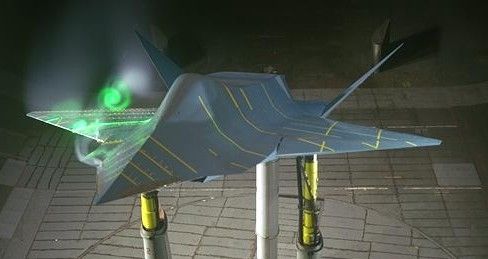
Vortex Lift in Cars and Planes
“Vortex lift is seen in a number of applications in aircraft and in nature. This principle is what makes, of all things, insects able to fly. Aerodynamic theory states that as an aerodynamic surface gets smaller, it becomes less efficient at generating lift. An insect's wing generates a vortex on the top surface (the low pressure side) which greatly increases the surface's ability to produce lift. Modern supersonic combat aircraft use this idea to increase subsonic aerodynamic performance. The strakes near the cockpit of a F-16 or F/A-18 generate vortices that run over the top side of the wing creating more efficient lift by inducing higher speed and therefore lower pressure. But these vortices aren't present in normal flight, and are only generated when the aircraft achieves a high angle of attack while either maneuvering or landing. Juha Kivekas points out, "in these conditions the flow stays attached at the incredible angles because of the vortex energy mix phenomenon". Or, stated more simply, flow separation is delayed by the rotating vortices which mixes the boundary layer flow and the main stream flow imparting energy to the more stagnant boundary layer.” Link.
How Tornadoes Work
(HowStuffWorks.com)Tornadoes and Your Bathtub

Q: How does a vortex form?
A: A drain's whirlpool, also known as a vortex, forms because of the downdraft the drain creates in the body of water. The downward flow of the water into the drain begins to rotate, and as the rotation speeds up, the vortex forms.
If you have ever seen a whirlpool form in your bathtub, sink or toilet when the water is draining, you have seen the fundamentals of a tornado at work. A drain's whirlpool, also known as a vortex, forms because of the downdraft that the drain creates in the body of water. The downward flow of the water into the drain begins to rotate, and as the rotation speeds up the vortex forms.
Why should the water start rotating? There are lots of explanations, but here is one way to think about it (and this way happens to apply to black holes as well as it does to drains). Imagine you are a particle in the water, and you are being pulled toward the suction that the drain creates. You are accelerating toward the point of suction. However, because of your previous momentum, the number of other particles getting sucked toward the point and other factors, chances are that you are going to be off to one side of the point of suction when you arrive. That deflection sets you up on a spiraling path into the point of suction, like a moth spiraling in toward a light. Once the spiral has started in one direction, it tends to influence all of the other particles as they arrive. A very strong spiraling tendency is created. Eventually, there is enough spiraling energy to create a vortex.
Given that you see vortexes all the time in tubs and sinks, it is obviously a fairly common phenomenon. In a tornado, the same sort of thing happens, except with air instead of water.
Practicing with the Chakras
In general:
Allow attention to go where it is called. If your chakras are calling you, answer the call.
Don’t impose chakras on yourself.
If a chakra hurts or aches, make sure to express from it as well as meditate on it.
Don’t visualize chakras. Your images will be too static. Use your senses of touch and motion.